Social Ecologies builds regenerative systems to catalyze ecological projects.
We specialize in multi-year, large-scale land restoration sites, as well as land services for homeowners & land stewards, communities & organizations, and businesses & institutions.
Engaging local residents
We build healthy habitats by directly engaging with the people who live and work there.
Instigating ecological projects
We encourage holistic, systematic thinking by inviting participation in all aspects of projects: from planning to implementation.
Building regenerative systems
We embody the belief that regenerative systems grow from ecologically-informed practice.
Our services translate scientific analysis into actionable steps for our clients.
For projects and partnerships Contact us︎︎︎

Process & Services
• ConsultationSocial Ecologies will start with a meeting to assess your needs and goals to figure out the scope of the project together. This initial consultation will also help us think through the characteristics and challenges your project might present.

We will come out for a site visit to see the land, meet you and your team, discuss your project to define services and schedule, and understand the situation and how to respond.
••• Research- Deeply mapping the land and neighboring spaces to gather information about local ecological and social histories.
- Sourcing local land survey and climate change data.
- Soil remediation tools and strategies.

- Soil analysis and testing as well as water sampling, testing, and interpretation.
- Local soil hydrology assessment.
- Plant and fungal community identification and description.
︎Site Plan
- Implementing regenerative soil building systems.
- Using mesophilic and thermophilic compost technologies.
- Applying anaerobic fermentation systems or Biochar.
- Using soil mycorrhizae to support plant growth, and establishing specific species of plants and fungi.
- Designing and implementing eco-sanitation systems.
︎Ground Work
- Instigating community design processes and working with land survey data.
- Providing trainings and workshops on topics such as soil remediation tools and strategies, applied ecology, and plant propagation.
- Recurring workshops include Deep Mapping, Biochar, and our signature Soil Science Certification and Training Program, The Soil Keepers.
︎Ongoing Support
Social Ecologies will continue providing support even after the project finishes. We are happy to answer questions, offer advice, and conduct follow-up site assessments for your project to track its progress and make additional recommendations as needed.UIC Plant Research Laboratory

Situation
-
Academic research and community space seeking programming on soil science, place-based learning, and local ecology.
Response
- Taught two day hands-on Introduction to Community Soil Science trainings based on The Soil Keepers program;
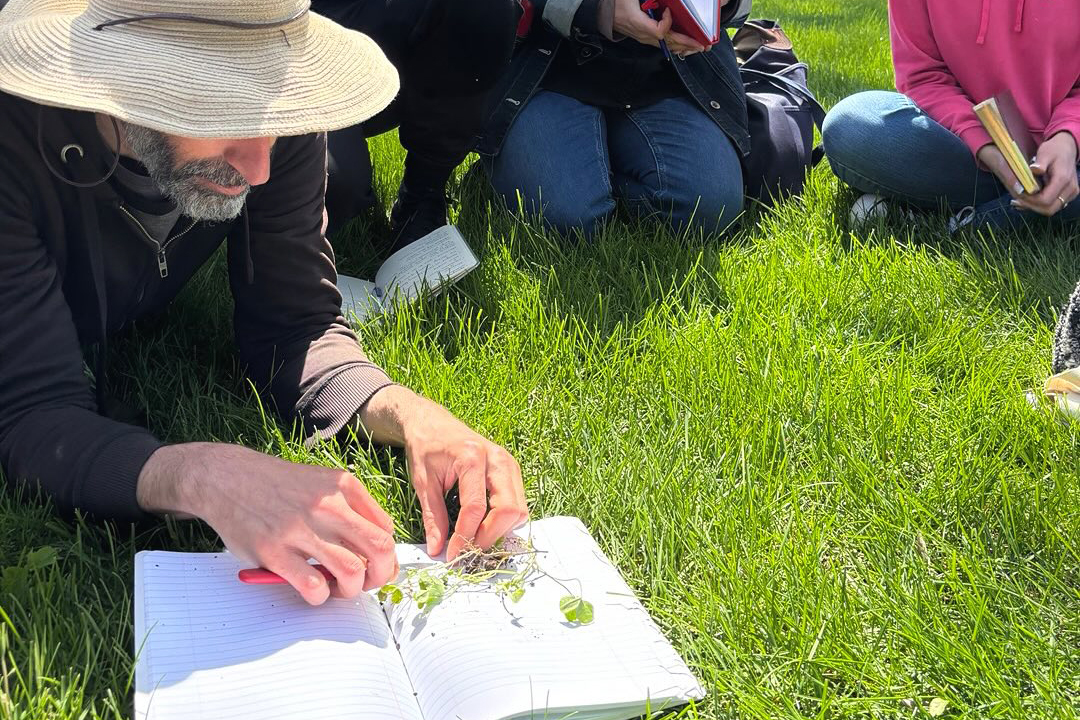
- Conducted walking lectures Soil Safari and Reading the Weeds.
More Work
Gwenyn Hill Farm
Situation
- Working regenerative farm in need of educational program on local rocks, minerals, and soils.
Response
- Taught half day hands-on, in-the-field soil study Beyond the Soil Test to farm staff and apprentice farmers.
Photography Gwenyn Hill Farm, Social Ecologies
More Work
Garfield Park Conservatory
Situation 1
-
Botanical garden and community space seeking higher level skill-based workshops for seasonal programming.
Response 1
- Facilitation of an Urban Agroecology Intensive, a self-contained theoretical training similar to what we offered at The Huntington in CA;
- Led Intermediate–Advanced Compost training series.
Situation 2
- Need for educational program on holistic soil science.
Response 2
- Taught two-day hands-on Introduction to Community Soil Science trainings, based on The Soil Keepers program.
Photography Benkrut, Social Ecologies
More Work
Art Institute of Chicago
Situation
- Need for consultation on soil composition and construction, for the artist Juliana Góngora Rojas and the group exhibition En El Principio (In The Beginning).
Response
- Designed, sourced, fabricated, and installed earthen floor feature.
Photography Lynn Becker, Knack Magazine, Social Ecologies
More Work
Elmhurst Art Museum
Situation
-
Looking for perspective and education on the topic of embodied soil studies in the Midwest landscape.
Response
- Conducted Soil Reading lecture and soil workshop in conjunction with the exhibition Sustenance and Land.
Photography Siegfried Mueller, Social Ecologies
More Work

Getting to know your soil is a world-building practice.
We offer hands-on, certificate-granting soil courses, as well as community engagement and consulting services for individuals, organizations, and communities working on projects of all scales.

Intro to Community Soil Science (on-line or in-person, offered on demand)
Virtual two part course on the physical and biological basics of soils with a focus on community learning context
Part I: Deep Time, rock types, physical soil structure and composition
Part II: Plants, fungi and bryophytes, soil microbiology, decomposition
Virtual two part course on the physical and biological basics of soils with a focus on community learning context
Part I: Deep Time, rock types, physical soil structure and composition
Part II: Plants, fungi and bryophytes, soil microbiology, decomposition
Applied Soil Science Certification Courses
The Body of Soil: Soil Geology (on-line, offered every Spring)
*Hands-on geology* as it can be applied to the soils you already work with or are curious about.
read more
You will be encouraged to engage through a combination of 10 hours of live online lectures, beautiful instructive films, discussions with your peers, and guided independent field work. You should be prepared to do 1-3 hours of field work with your soil per week which you will be sharing with your instructor and cohort.
Main topics include:
See full course description and details on Eventbrite︎︎︎
*Hands-on geology* as it can be applied to the soils you already work with or are curious about.
read more
You will be encouraged to engage through a combination of 10 hours of live online lectures, beautiful instructive films, discussions with your peers, and guided independent field work. You should be prepared to do 1-3 hours of field work with your soil per week which you will be sharing with your instructor and cohort.
Main topics include:
- Deep time and the rock cycle
- Crystallization
- Mohs scale
- Soil types and their characteristics
- Soil structure and aggregation
- Soil color and major minerals
- Common elements and how they work with biology
- Methods of soil evaluation in the field
See full course description and details on Eventbrite︎︎︎
The Life of Soil: Soil Biology (on-line, offered every Fall)
*Hands-on biology* as it can be applied to the soils you already work with or are curious about
read more
In this course, you will be encouraged to engage through a combination of 12.5 hours of live online lectures, beautiful instructive films, discussions with your peers, and guided independent field work. You should be prepared to do 1-3 hours of field work with your soil per week which you will be sharing with your instructor and cohort. Attending all four classes is necessary for course certification.
Main topics include:
- Plants and plant communities
- Roots
- Rhizosphere and attendant microbial communities
- Bryophytes – lichens, ferns, mosses, liverworts, hornworts, etc.
- Fungi
- Mycorrhizae and their plant allies
- Decomposition
- Compost technologies and organic soil amendments
See full course description and details on Eventbrite︎︎︎

The Mind of Soil: Soil Chemistry (on-line, offered every Winter)
*Hands-on chemistry* as it can be applied to the soils you already work with or are curious about
read more
In this course, you will be encouraged to engage through a combination of 10 hours of live online lectures, discussions with your peers, and guided independent field work. You should be prepared to do 1-3 hours of field work/kitchen lab work per week with your soil. Attending all four classes is necessary for course certification.
Main topics include:
**Prerequisites**
1. Completion of either our The Life of Soil: Soil Biology or The Body of Soil: Soil Geology courses or demonstrated equivalent of solid working understanding of either biology or geology.
2. Two cups of correctly sampled soil to submit for lab testing. (contact us: soilkeepers@protonmail.com should you have any questions)
See full course description and details on Eventbrite︎︎︎
*Hands-on chemistry* as it can be applied to the soils you already work with or are curious about
read more
In this course, you will be encouraged to engage through a combination of 10 hours of live online lectures, discussions with your peers, and guided independent field work. You should be prepared to do 1-3 hours of field work/kitchen lab work per week with your soil. Attending all four classes is necessary for course certification.
Main topics include:
- history of chemistry
- elements and the Periodic Table
- carbon and hydrocarbons
- water and other solvents
- compounds and bonding
- phase change and temperature
- acids, bases, and pH
- oxidation and reduction
- alcohols and salts
- soil testing
- contamination – microplastics, heavy metals, organic compounds, PFAS
**Prerequisites**
1. Completion of either our The Life of Soil: Soil Biology or The Body of Soil: Soil Geology courses or demonstrated equivalent of solid working understanding of either biology or geology.
2. Two cups of correctly sampled soil to submit for lab testing. (contact us: soilkeepers@protonmail.com should you have any questions)
See full course description and details on Eventbrite︎︎︎

Capstone Remediation Project (on-line, offered yearly Spring thru Fall, 6 month supported project development)

Upon completion of all three courses + capstone project,
students will receive their Soil Diploma
Contact us︎︎︎ to set up a consultation
Community Engagement
Projects with clients involving The Soil Keepers workshops and curriculum include Amisacho Restauración, Archeworks, Comer Youth Farm, Southeast Environmental Task Force, and UIC Plant Research Laboratory.
- Is your restoration project community-led or a civic brownfield project? Our signature program catalyzes community engagement with outreach, education, and strategic partnerships through workshops and trainings based on The Soil Keepers framework.
- Modified from our more comprehensive certification units, these trainings focus on the needs of the site and build the capacities and networks of the community.
Projects with clients involving The Soil Keepers workshops and curriculum include Amisacho Restauración, Archeworks, Comer Youth Farm, Southeast Environmental Task Force, and UIC Plant Research Laboratory.
Get in touch with Social Ecologies if you have a project to discuss or inquiries about our services.
“Social Ecologies creates durational projects that aim to build healthy habitat and interaction through direct engagement of place with those who dwell there. We seek to encourage holistic, systematic thinking through varying levels and degrees of project participation. Projects are typically birthed and supported for several years. Substantial research, learning and dialogue is used to develop and allow for ideas to emerge. Social Ecologies believes embodiment fuels continuing action.”
︎ Nance Klehm, Founder and Director of Operations
If you'd like to reach Social Ecologies directly, please email info@socialecologies.net for serious inquiries, or send us a message on Instagram @social.ecologies for informal contact.
Team
Nance Klehm
︎Founder and Director of OperationsNance Klehm has been an ecological systems designer, landscaper, horticultural consultant, and agroecological grower for more than three decades. Her approach is centered on instigating change by activating already existent communities, and her work demonstrates her lifelong commitment to redefining the way human populations coexist with plant and animal systems on this planet.
A consultant, speaker, and teacher, Nance is internationally respected for her work on land politics and soil health. Her work has received extensive national and international media coverage and is mentioned in many books, including Leila Darwish’s Earth Repair and Sandor Katz’s The Revolution Will Not Be Microwaved. She won the 2012 Utne Visionary Prize and has been a two-time finalist for the Curry-Stone Design Prize. In addition, she has lectured broadly in museum and university settings as well as for countless community groups worldwide. Most recently, she was the subject of the independent documentary Weedeater.
She currently splits her time between Little Village, a densely packed, diverse urban neighborhood in the heart of Chicago, and fifty acres of land in the Driftless Region of northwest Illinois, where she cultivates and forages medicinal and edible plants and fungi, keeps bees and a fruit orchard, raises ducks and quail, and grows for indigenous seed banks.
Jacob Blecher
︎Director of ResearchJacob Blecher is interested in adaptive agroforestry practices which take into consideration climatological and human development disturbances, and in ways of bootstrapping land regeneration with minimal resources. With Social Ecologies, he’s helped develop community composting and bioremediation projects in Chicago. He holds a BA from Yale University and an MA in Political Science from the University of Chicago, and is based in New York City.
Elliot Heilman
︎AssistantElliot is an assistant at Social Ecologies, where he helps with everything from communications to grantwriting and technology. Before joining Social Ecologies, Elliot worked as a resource coordinator and mediator in Cook County eviction court and as a program manager for Illinois Humanities, where he helped to coordinate community-led discussion programs about public policy issues such as criminal justice reform. He lives in Little Village with his partner, child, and Red, pictured here.